
Drawings made of a rehearsal, rehearsal technique is a matter of profound significance, not simply a method of memorizing text and actions it is a paralingual ritual taking the form of a loose meeting up of aspirations, concepts and conceits, there is hierarchy, there is anarchy, there is democracy, there are codified actions and signals. The world of the displaced slightly mauled furniture, discarded sweater, dog eared scribbled over play texts, random props and drinks cartons - in fact a hollow perplexing mix of values, either an actors prop or a bit of rubbish, the rehearsal room cleaners dilemma, to throw or carefully preserve, to sweep around the fast food wrapper converting its status to a small zen garden.
That world I'm describing, of the average rehearsal room seen as seedy, incorporate, human. Actors and technicians spend all day in there, its like a diary of disparate lives since most of what happens is internalized, contemplated or simply observed, the displays are provisional and impartial, they are links and severed strands in need of an order, a disorder.
A rehearsal for performance purposes can take practically any form from a simple meeting and discussion with dialogue, a Bauprobe where the chorus and repetiteurs might walk through the staging of an already designed but not yet fully produced opera production in order to guage the impact of performer and scenery in the ultimate location. The significant element in this process is stage management which acts as the total interface for all these strands of context to combine and unify. Stage Management is quantified by its lack of visibility, the success of coralling these various flights of fancy, personal insights and group passions is down to the dogged communication and investigation of the stage managers who are only identified when things go wrong but who are otherwise invisible.
The rehearsal room of any producing theatre is reminiscent of the artists studio, a place increasingly devolved from turpentine and rags, brushes, camera's, printing presses and linen to name a few olfactory signals that may conjure a sense of place. There is another semi olfactory, sensory experience received in places where the mind is active in a freewheeling reciprocal way, the smell of wordplay, the taste of colours, the sight of enchantment, raging and whispering. Nowhere like the world and yet a condensed and saturated version. A group of people on a roll.

Macbeth rehearsal group "sharing"whilst the dramaturgical character and style evolves.

A rehearsal room splinter group in the early throws in the big scheme of things, not yet off book but totally "immersed"in the landscape of the text.
graphite,gesso,gouache on cartridge by Jonathan Polkest.
  |
| Drawings of the Penny-Rebbeck Macbeth with Pete Postlethwaite in the leading role, biro, graphite and wax on gesso paper by Jonathan Polkest |
 | |
| Rehearsing a part of a scene for Macbeth | Biro Drawing by Jonathan Polkest |
 | ||||||
| Overlapping sequence of actors in the rehearsal space reading, reciting and ruminating. |
 | |
| Stretching and Breathing exercises during and before rehearsal at the Bristol Old Vic for the Macbeth cast. |
 | ||
| In the Rehearsal Room by Jonathan Polkest. |
Drawings of Macbeth Rehearsals at Bristol Old Vic by Jonathan Polkest with commentary on rehearsal techniques and seminal ideas about rehearsal technique. A Brief look at Rehearsal in Production. Space, Body Spectator or Actors, play, and audience? Realizing potential for performance, always benefits from Direction or a defined point of view to penetrate and infuse the collective energies with flow. Often that role is undertaken by a director. A director should provide leadership, without being overbearing or boorish, whether it's a staged reading to a congregation, a reader's theatre performance at reunion, or a full scale theatre production. A director may take responsibility for the combined aspects of a production, as an artist he or she nurtures a vision from the collaboration that ties their own performance elements with those of the text, the space, the performers and makers and organizers. (the company).  Directing as an art form became prominent during the late nineteenth
century emerging from a prevailing societal reliance upon rank and authority. In one form or another "Directors" probably existed since the classical
Greek theatre when the didaskalos, meaning teacher,
instructed the performers. Directing as an art form became prominent during the late nineteenth
century emerging from a prevailing societal reliance upon rank and authority. In one form or another "Directors" probably existed since the classical
Greek theatre when the didaskalos, meaning teacher,
instructed the performers.The Medieval theatre employed stage managers called conducteurs de secrets. Shakespeare may have embarked on some recognizable elements of directing his company at the Globe Theatre during the Elizabethan age. And Moliere, it is said :coached his company. From
1750 to 1850, the manager/director or actor/manager/director became
promenant. Developments helped to shape the need for a director at this
time with rising standards in education and literacy, social awareness of antiquarianism, the technological development of scenery, and the focus on naturalistic production values.
The
director with a capital D impacted the theatre world
in 1874 when the Duke of Saxe-Meiningen toured Europe with his troupe
of actors. The tour presented theatre artists with the value and artistic opportunity
a director could use. Although somewhat "wooden" by contemporary standards the Duke of Saxe-Meiningen developed and introduced crude directing principles which continue in some modified formats
to this day. His principles included intensive rehearsals, the demand for disciplined
and interactive performing, historically accurate sets and costumes, extensive
use of staging and masking, the directorial need for total visual control
over all aspects of the production, and the value of ornament/ detail.Overall, some of
the practices implemented by the Duke of Saxe-Meiningen exist today.
The director has two basic charges: to implement or coax a unified vision
within the finished production, and to lead the ensemble toward its ultimate
actualization.The director invokes the interpretation of the play, with the blessing of the playwright (if possible), by inviting particular designers, and technicians in planning the production, by casting and by the system of rehearsal used by the actors, and allow all elements to conspire into the finished production. Before
rehearsals begin, the director meets with the designers. At this time,
the director exchanges ideas and listens to
ideas from the other artists. This intercourse results
in compromise. The traditional heirarchical idea that the director
decides upon the interpretation continues to prevail although the idea of dramaturgy and some operatic systems of collaboration have infused companies with a more democratic approach. The director may have specific
requirements that would need to be presented to the designers before their
work begins. When
casting a play, the director is aware of the physical demands of a character.
Physical appearance must fit the character. For example, a thin Falstaff
would tell a new story, a very different interpretation of Falstaff could emerge or the whole thing could fail. Physical appearance must also be seen in
relation to other characters in order to perceive that person's suitability
to the ensemble as a whole.
Rehearsal is the Directors most time consuming production factor. The director focuses upon the entire cast during this time.
The director's medium is the actor in space and time. Space is defined
by the acting area and the setting while time is defined by the duration
of the production and the dynamics of the drama.Directors
tend to follow an established process during rehearsals. the
director usually invites the actors read through the script, occasionally a good director gets the entire company to read through. The read-through
allows the director to influence character motivation,
and interpretation pointing the actors towards their characters
in terms of an agreed understanding. The director blocks the actors.
Blocking is an actor's basic broad movements which will develop the physical correlation of the actor's performance. The director indicates movement
such as entrances and exits and positions onstage although good stage management (invisible so far in this description) always "spikes" the entrances and exits from reading a scale groundplan and transposing doorways, or edges with small pieces of coloured tape. Detail, which helps indicate subtleties in his
or her character. Detail includes working out stage business,
an actor's less physically obvious movement. For example, fixing a drink, making
a phone call, hanging clothes, or other habitual characteristics are pieces of stage business. The actor will wish to originate his or her own stage business.Motivation
and detail continue while time is spent devoted to lines. Interpretation
of dialogue must be connected to motivation and detail. During this time,
the director is also concerned with pace and seeks a variation of tempo.
If the overall pace is too slow, then the action loses its fresh quality.
If the pace hastens, it could be less comprehensible to the audience.Also,
eventually, the actors will need to be off script. Once off script and
the lines are memorized well enough that the actor is not thinking "What
is my next line?" then the rehearsals enter into a very rewarding
stage of development. For actors cease to read their part and truly make
it living. They also discover new avenues of interpretation once off script.Late
in the rehearsal process, the director often has the actors run through
the production. A runthrough gives the actors a sense of continuity from
one scene to the next. At this stage, the director usually does not stop
the actors but takes notes to give after the scene is finished.Drawings of Macbeth Rehearsals at Bristol Old Vic by Jonathan Polkest with commentary on rehearsal techniques and seminal ideas about rehearsal technique.  “Artists are recording our times, in the future this is what society will look back on as a record of our age… Responsibility as an artist is to not say what something is, but to ask what it is… There’s nothing wrong in having an interpretation, but we must not insist that it’s the whole truth.” Robert Wilson The theatre of Robert Wilson is rooted in the visual arts. He creates a highly associative world, in which ideas and emotions are communicated non-linearly, outside the narrative structure of story. We may not know what his work means but it affects us. Pieces unfold like visual music where meaning is perceived subconsciously, on an “interior screen”, where we all share a universal language. This is where reality exists for Robert Wilson. The ProcessThe conception of a piece is a process of building up layers, beginning with visual imagery, proceeding to stage movement, and later to costumes, words, music and scenic designs.Wilson begins with a series of sketches in which he outlines the entire work. To these are added visual images from a variety of sources, along with texts and general ideas. The result is a “visual book” from which the entire production is built – not a script or a score, as in traditional theatre. Wilson next develops patterns of movement emblematic of each character, fitting the characters together and refining the visual presentation. Each scene becomes a living painting. Wilson operates in the manner of a visual artist, adding the theatrical equivalents of colour, shading, and texture as he goes along. At the same time he develops ideas for stage properties, lighting, and costumes. Like a tapestry woven together, visual and audio themes occur and recur, always the same, always different… What is so compelling about Wilson is that he tries to banish the accidental from the stage. After sketching out the general rhythm and movement of the piece, Wilson studies each means of expression. Every movement – whether a nod of the head, a twitch of the hand, or a repositioning of the arm – is planned and staged. Every costume, every prop, every chair is designed specifically for the production, and placed with precision to make everything on the stage balance with the story being told.  Conversation between John Tusa and Robert Lepage regarding performance and the dynamics of staging. At a very early stage I think you found that being on the stage with actors was a real personal and psychological liberation. Has that sense of being freed by being on the stage has that ever left you? No never and I think it has a lot to do with the fact I'm a very shy person. I mean for, for somebody who, who's in the world of communication and, and you know an actor on stage has to be everything but shy, but I'm a very, very, very shy person so the theatre allows me to hide behind the group phenomenon. Theatre is, is one of these artistic expressions that don't exist if there's not, a community or a collectivity around it. But you do do one man shows. Yes I do do one man shows but I never call them one man shows, because there's so many people in the rehearsal room that take responsibility for whatever happens. It's, it's difficult for me to, to express myself as a solo artist, and even if I do, I do call myself a director and I do put myself up front and, and defend my work, but as I say I'm a very, very shy person, so and theatres are full of costumes and sets and masks you could hide behind, and I think my, my life is about trying to get rid slowly and slowly of those crutches and to present myself as I am. Because I think you said probably some time ago though, when you went on the stage, if speaking made me uncomfortable I could use gestures, if that wasn't enough I could move and use space and light. Are you suggesting that you are now moving to a position where just being on the stage and speaking is something that you're happy with and you say you don't have to rely on these crutches of technical support? Yeah actually I have this idea for a project that I'll be developing in the next few years about voice, it's called Lip Sync and I'm forcing myself to go towards that, the simplicity of just standing there and speaking, and before, before you get to that you have to go through all the different possibilities and of course dance is one, movement is one, architecture is one, imagery is one, and so once you've tried every other avenue you naturally, I think theatre naturally brings you to the spoken word, but you have to be ready for that and, and if it takes a whole career to get there then, and, and I prefer that because I think that unfortunately the word is too often the starting point of theatre and, and that gives way to one kind of theatrical expression. I think an image could also trigger theatrical expression and maybe the word is the final thing.  The Suzuki Method of Actor Training drawings made in rehearsal of Macbeth accompanied rehearsal system commentary. Looking at Drawings in Performance (rehearsal) by Jonathan Polkest. Tadashi Suzuki (born June 20, 1939) is a theatre director, writer and philosopher working out of Toga, Toyama, Japan. Suzuki is the founder and director of the Suzuki Company of Toga (SCOT), organizer of Japan’s first international theatre festival (Toga Festival), together with director Anne Bogart he co-founded the Saratoga International Theatre Institute in Saratoga Springs, New York, and creator of the Suzuki Method of Actor Training. Suzuki also was General Artistic Director of Shizuoka Performing Arts Center (SPAC)(1995~2007), an international committee member of the Theatre Olympics, founding member of the BeSeTo Festival (jointly organized by leading theatre artists from Japan, China and Korea) and Chairman of the Board of Directors for the Japan Performing Arts Foundation, a nation-wide network of theatre professionals in Japan. Suzuki’s works include “On the Dramatic Passions”", “The Trojan Women”, “Dionysus”, “King Lear”, “Cyrano de Bergerac”, “Madame de Sade”, etc. Besides productions with his own company, he has directed several international collaborations, such as The Tale of Lear, co-produced and presented by four leading regional theatres in the US”;King Lear, presented with the Moscow Art Theatre; Oedipus Rex, co-produced by Cultural Olympiad and the Düsseldorf Schauspielhaus; and Electra, produced by Ansan Arts Center / Arco Arts Theatre in Korea and the Taganka Theatre in Russia. Suzuki has articulated his theories in a number of books. A collection of his writings in English, The Way of Acting is published by Theatre Communications Group (US). He has taught his system of actor training in schools and theatres throughout the world, including The Juilliard School in New York and the Moscow Art Theatre. The Cambridge University Press published The Theatre of Suzuki Tadashi as part of their Directors in Perspective series, featuring leading theatre directors of the 20th Century. This series includes works on Meyerhold, Brecht, Strehler, Peter Brook and Robert Wilson among others.   Rehearsing in Public by Michael Simpkins in the Guardian 2008 Nicholas Hytner's suggestion that rehearsals of plays should be "visible and accessible" to the public will have instantly tightened the sphincter of every actor in Britain. Hytner is well known for thinking "outside the box". Indeed, his extraordinary ability to carry his troops through innovative and often terrifying processes of change is what has made his tenure at the National Theatre so stupendously successful. But rehearsals open to the public? The prospect is terrifying. Families wandering through in lengthy crocodiles, parents with headphones clamped to their ears pumping out background commentaries: "The play being rehearsed is one of Chekhov's finest. Unfortunately that middle-aged actor/writer from north London who said he could play the mandolin in order to get the role is sadly deficient, which is why he's holding the instrument the wrong way up while the director is staring thunderously at him from the corner.) And the sacred space that represents our precious cherry orchard inundated by discarded crisps and trails of Haagen-Dazs? Whoa ... The rehearsal room is one of the last bastions of privacy. Like the Lord's pavilion for old buffers or the changing cubicles in high-street stores for middle-aged women, the rehearsal room is the only space in which actors can make fools of themselves, where we can examine the size of our arses in the mirror or dribble down our blazers after a hearty lunch. It's all about experimentation isn't it? Indeed, when I first worked at the NT in the early 80s you couldn't see in a rehearsal room even if you were in the production. The only aperture, a small glass panel at eye level in the single entrance door, was habitually stopped up from the inside with masking tape or sheets of paper to stop prying eyes. Every time you entered you took your life in your hands, hoping the hinges wouldn't squeak just as the leading actor was reaching his big moment. First-night nerves were a doddle by comparison. And when I think of some of the terrible things I've served up in the privacy of the rehearsal process: the idea I had to play one role in a West Country accent; the first time I had to take my clothes off. The notion of the paying public being able to view my shambolic efforts is more horrifying than I can describe. But Hytner is nothing if not inspired. His idea will probably be a fantastic success, leading to a whole new understanding of live arts among the general population, and heralding in a whole new golden age of drama appreciation. I really wouldn't put it past him.  Antonin Artaud was highly influential in shaping physical theatre - rejecting the primacy of the text and suggesting a theatre in which the proscenium arch is disposed of in order to engage a direct relationship with the audience. Eastern Theatre traditions also influenced a number of practitioners who influenced physical theatre. A number of Oriental traditions have a high level of physical training, and are highly visual. The Japanese Noh tradition, in particular has been drawn upon a lot. Antonin Artaud was fascinated with the energy and visual nature of Balinese theatre and wrote extensively on it. Noh has been important for many practitioners including Lecoq who based his neutral mask on the calm mask of Noh. Jerzy Grotowski, Peter Brook, Jacques Copeau and Joan Littlewood have all been consciously influenced by Noh. Alongside contemporary western practitioners, certain Japanese Theatre Practitioners were influenced by their own traditions. Tadashi Suzuki drew partly on Noh and his highly physical training has been disseminated into the west by his students and collaborators. This has particularly happened through Anne Bogart's Collaboration with him and the simultaneous training of her actors in both the Viewpoints method and Suzuki training. As well as Suzuki, the Butoh Movement, which originated from Tatsumi Hijikata and Kazuo Ohno contained elements of Noh imagery and physicality. Butoh, again, in term has been influencing Western practitioners in recent years and has certain similarities with Lecoq's mime training in terms of ideas (impression and consequential embodiment of imagery, use of mask etc.) As well as ideas outside of the western theatre tradition creeping in gradually, there is a tradition from within Western theatre, too, starting with Stanislavski. Stanislavski, later on in life, began to reject his own ideas of naturalism, and started to pursue ideas relating to the physical body in performance. Meyerhold and Grotowski developed these ideas and began to develop actor training that included a very high level of physical training. This work influenced and was developed further by Peter Brook. Contemporary dance has added to this mix significantly, starting particularly with Rudolf von Laban. Laban developed a way of looking at movement outside of codified dance and was useful in at looking at, and creating, movement not just for dancers but for actors too. Later on the Tanzteater of Pina Bausch and others looked at the relationship between dance and theatre. In America, the postmodern dance movement of the Judson Church Dance also began to influence theatre practitioners, as their suggestions for movement and somatic training are equally accessible for those with a dance training as those with a theatre training. Indeed, Steve Paxton taught theatre students at Dartington College of Arts and other institutions  Physical theatre descended from a variety of origins. Mime and theatrical clowning schools, such as L'École Internationale de Théâtre Jacques Lecoq in Paris, have had a big influence on expressions of physical theatre, and practitioners. Contemporary Dance has also had an influence on what we regard as physical theatre, partly because most physical theatre requires actors to have a level of physical control and flexibility rarely found in those who do not have some sort of movement background. Modern physical theatre also has strong roots in more ancient traditions such as Commedia dell'arte and some suggest links to the ancient greek theatre, particularly the theatre of Aristophanes. Another tradition started with the very famous French master Etienne Decroux (father of corporeal mime). Etienne Decroux's aim was to create a theatre based on the physicality of the actor allowing the creation of a more metaphorical theatre. This tradition has now grown and corporeal mime is taught in many major theatrical schools. Daniel Stein, a teacher out of the lineage of Etienne Decroux, has this to say about physical theatre: "I think physical theatre is much more visceral and audiences are affected much more viscerally than intellectually. The foundation of theater is a live, human experience, which is different from any other form of art that I know of. Live theatre, where real human beings are standing in front of real human beings, is about the fact that we have all set aside this hour; the sharing goes in both directions. The fact that it is a very physical, visceral form makes it a very different experience from almost anything else that we partake of in our lives. I don’t think we could do it the same way if we were doing literary-based theatre.The point at which, arguably, physical theatre became distinct from pure mime is when Jean-Louis Barrault (a student of Decroux) rejected his teacher's notion that the mime should be silent, deciding that if a mime uses their voice then they have a whole range of possibilities open to them that previously would not have existed. This idea became known as "Total Theatre" and he advocated that no theatrical element should assume primacy over another: movement, music, visual image, text etc. being viewed as equally important, and that each should be explored for their possibilities. Barrault was a member of Michel St.Denis's company, alongside Antonin Artaud.  Physical theatre is used to describe any mode of performance that pursues storytelling or drama through primarily physical and secondarily and mental means. Several traditions of performance all describe themselves as "physical theatre", which has led to considerable confusion as to how physical theatre should be defined. The means of expression seem to be primarily physical rather than textual, often with emphasis on musical elements. Many of these various Physical Theatre traditions share a collaborative devising approach to theatrical development and creation; various groups, such as DV8, Frantic Assembly and the Forced Entertainment all use differing but nonetheless devising-based processes. Some analysts believe that physical theatre was influenced by Bertolt Brecht. Dympha Callery suggests that physical theatre shares some common characteristics, even though the definition of physical theatre is still problematic, they all are not necessarily true all the time, and that these examples are not exhaustive.  Regietheater Regietheater (German for director's theater or producer's theater) is a term that refers to a contemporary practice of allowing a director (or producer) total freedom in devising the way a given opera (or play) is staged so that the composer's original, specific stage directions (where supplied) can be changed, together with major elements of geographical location, chronological situation, casting and plot.  drawing by Jonathan Polkest Grotowski revolutionized theatrical process and made a profound impact on the way acting is valued both he and Eugenio Barba, made a very considerable impact upon all forms of contemporary theatre. Barba was instrumental in revealing Grotowski to the world. The editor of the seminal book, Towards a Poor Theatre (1968) which Grotowski wrote together with Ludwik Flaszen, proposed that theatre should not compete against the overwhelming spectacle of film and should instead focus on the very root of the act of theatre: live actors co-creating the event of theatre with its spectators. Theatre - derived through the actor's technique, his art in which he strives for total consciousness and higher motives - establishing an opportunity for what could be called integration, the discarding of masks, the revealing of the real substance: a totality of physical and mental reactions. This action is treated as a discipline, with a full awareness of the responsibilities it involves. Here we can see the theatre's therapeutic function for people in contemporary societies. The actor accomplishes this act, but he can only do so through a reaction with the spectator - intimately, visibly, not through a lens, or a microphone, not a wardrobe, or set designer - in direct confrontation with the living actor, and somehow " instead of" him. The actor's act - discarding half measures, revealing, opening up, emerging from himself as opposed to closing up - is an invitation to the spectator. This act could be compared to an act of the embedded, genuine love between two human beings - this is just a comparison since we can only refer to this "emergence from oneself" through analogy. This act, paradoxical and borderline, we call a total act. It epitomizes the actor's deepest calling.  In 1968 Jerzy Grotowski became familiar to a broader public realm. His company performed the Stanislaw Wyspianski play Akropolis/Acropolis (1964) at the Edinburgh Festival. The production and technique had been well received in Poland achieving wider recognition, and was published in Pamiętnik Teatralny (Warsaw, 1964), Alla Ricerca del Teatro Perduto (Padova, 1965), and Tulane Drama Review (New Orleans, 1965). Being the first time many in Britain had been exposed to the concept of "Poor Theatre". That same year Towards A Poor Theatre appeared in Danish, published by Odin Teatrets Forlag. It appeared in English the following year, published by Methuen and Co. Ltd., with an Introduction by Peter Brook, then Director of the Royal Shakespeare Company  Jerzy Grotowski - toward a Poor Theatre. Grotowski was interested in archetypes; movements, sounds and situations basic to the human condition and broadly understandable across human cultures. He used them as powerful tools for his actors to communicate with the audience at a very basic level. Perhaps this is similar to Artaud's symbolist drama. Both Grotowski and Artaud looked to symbolism and ritual as theatrical sources, but they developed and employed them differently. Artaud's theatre might be seen as therapeutic because it entails 'acting out' and might be cathartic for the actor or the audience, breaking free of restrictions that keep one from being fully alive. Grotowski's technique of working with the actor who 'makes a gift of himself' is reminiscent of psychoanalysis, as the patient freely talks about whatever enters his mind, but this is not what working with the technique was like in practice, nor would Grotowski agree that this was in any way an objective of the work. In rehearsal the actors work from within themselves, concentrating on the physical movements in an almost meditative manner. Grotowski, as the director, would suggest and guide, and would ultimately select the movements and sounds that would continue to be part of the work in progress. I believe he was fascinated with this creative aspect of the rehearsal process, and as he moved more away from directing public performances after 1973, he was ultimately more interested in the rehearsal process than the performance. In reference to the idea of 'Holy' as applied to theatre, again they had different approaches. Artaud's 'Holy Theatre', to me, seems holy in the way that the Hindu god Kali is holy, an awesome power that is both creator and destroyer. Grotowski's reference to 'Holy Theatre' generally applies to the dedication of the actor, in giving himself as a gift, an almost saintly holiness which carries over to a performance which is transcendent in a much more subtle, human sized way. -Owen Daly  Peter Brooks - The Empty Space.
In
a reaction to Realism, some artists like Peter Brook or the Living Theatre,
deemphasized the realism of theatre. Instead, they preferred to emphasize the
communication between the actors and the audience. This focus, summed up in
Antonin Artaud’s phrase “Theatre of Cruelty,” was directed at eliciting the
greatest emotional reaction from audience members. In other words, make them
squirm uncomfortably in their seats. Some of these directing exercises show
this change in focus, as they try to get actors to go beyond the “text,”
expressing emotions much more physically. Criticized by some as “calisthentics”
rather than provoking “artistic expression for its own sake”

“Tradition itself, in times of dogmatism and dogmatic revolution, is a revolutionary force which must be safeguarded.”
Peter Brook
~ • ~
Theatre and TraditionThe inquirey into the meaning of theatre, led Peter Brook towards an investigation of Tradition. That theatre sprang from life, then life must be questioned. Understanding theatrical reality also entails understanding the agents of that reality, the participants in any theatrical event: artists, actors, director, spectators. For a man who rejects all dogma and closed systems of thought, Tradition offers the ideal characteristic of unity in contradiction. Although it asserts its immutable nature, nevertheless it appears in forms of an immense heterogeneity: while devoting itself to the understanding of unity, it does so by focusing its concerns on the infinite diversity of reality. Tradition conceives of understanding as being something originally engendered by experience, beyond all explanation and theoretical generalisation.Even on the most superficial of levels, Brook’s interest in Tradition is self-evident: one thinks of his theatre adaptation of one of the jewels of Sufi art, Attar’s Conference of the Birds, of his film taken from Gurdjieff’s book Meetings with Remarkable Men, and of the subsequent work on The Mahabharata. Clearly an investigation of the points of convergence between Brook’s theatre work and traditional thought is not devoid of purpose.  Peter Brooks approach. In 1900, Max Planck introduced the concept of the ‘elementary quantum of action,’ a theory in physics based on the notion of continuity: energy has a discreet, discontinuous structure. In 1905, Einstein formulated his theory of relativity, revealing a new relationship between space and time: it would contribute to a radical reevaluation of the object/energy hierarchy. Gradually, the notion of an object would be replaced by that of an ‘event,’ a ‘relationship’ and an ‘interconnection’—real movement being that of energy. Quantum mechanics as a theory was elaborated much later, around 1930: it shattered the concept of identity in a classical particle. For the first time, the possibility of a space/time discontinuum was recognised as logically valid. And finally the theory of elementary particles—a continuation of both quantum mechanics and the theory of relativity, as well as an attempt to go beyond both of these physical theories—is still in the process of elaboration today. Like both contemporary scientists and Gurdjieff, Brook is convinced of the materiality of energy. Describing the characteristics of ‘rough theatre,’ he writes: The Holy Theatre has one energy, the Rough has others. Lightheartedness and gaiety feed it, but so does the same energy that produces rebellion and opposition. This is a militant energy: it is the energy of anger, sometimes the energy of hate.  Michael Checkov Chekhov's description of his acting technique, On the Technique of Acting, was written in 1912. When reissued in 1991 it had additional material by Chekhov estate executor Mala Powers; an abridged version appeared under the title, To the Actor, which was published in 1953 and reissued in 2002 with an additional foreword by Simon Callow and additional Russian material translated and commented on by Andrei Malaev-Babel. Among the most influential acting teachers of the century, Michael Chekhov is also one of the most obscure, at least in America (where he lived and worked the latter part of his life, dying in 1955 on the same day as James Dean.)
Although many of Chekhov’s exercises are used widely in acting
programs, there are only a handful of teachers who focus on Chekhov’s approach probably because of the mystical element in his theories.
Chekhov was a follower of Rudolf Steiner, an Austrian who formulated a belief
system called Anthroposophy. Chekhov’s book “On
the Technique of Acting” (published in 1991 based on earlier writings), regardless of any spiritual beliefs promotes
down-to-earth advice for the actor. Chekhov wrote, “The desire and the
ability to transform oneself are the very heart of the actor’s
nature.
The English translation of his autobiography The Path of the Actor
was edited by Andrei Kirillov and Bella Merlin, and was published by
Routledge in 2005, marking the 50th anniversary of his death.The documentary From Russia to Hollywood: the 100 Year Odyssey of Chekhov and Shdanoff, profiles Chekhov and his fellow Russian associate George Shdanoff; released in 1998, it is narrated by Gregory Peck, who starred in Alfred Hitchcock's film Spellbound, for which Chekhov earned an Oscar Nomination. 
an actor involved in some physical techniques.
graphite; gesso ; paper published in a limited run.
Following Stanislavski's approach to the rehearsal system Michael Chekhov explored
and addressed the question of how to access the unconscious self
through indirect non-analytical means. Chekhov taught a range of
movement dynamics such as molding, floating, flying, and radiating that
actors use to find the physical core of acharacter.
His rehearsal techniques, though seemingly external, are intended to lead the actor
to a richer internal life. In spite of his reputation as an actor and his
first-hand experience in the development of Stanislavski's
groundbreaking work, Chekhov as a teacher was overshadowed by his
American counterparts (see below) in the 1940s and 1950s and their interpretations
of Stanislavski's 'system,' which became known as Method acting. Interest in Chekhov's work has grown, however, with a new generation of teachers. Chekhov's own students included Marilyn Monroe, Anthony Quinn, Clint Eastwood, Mala Powers, Yul Brynner, Patricia Neal, Sterling Hayden, Jack Palance, Elia Kazan, Paula Strasberg, Lloyd Bridges and his wife, Dorothy Bridges. In the television programme Inside the Actors Studio, noted actors such as Johnny Depp and Anthony Hopkins have cited Chekhov's book as highly influential on their acting technique, I'm not implying that George Costigan or Pete Postlethwaite were disciples or even approved of any system of rehearsal, I'm simply using this space to present a few images alongside this enquirey.

A rewind into the annals of memorizing and rehearsing the preliminary.
Drawings made of rehearsals prior to the 1998 tour of Macbeth in Bristol Old Vic Theatre, a Rebbeck Penny production starring Pete Postlethwaite, the drawings are figurative illustrations which were published and exhibited during the tour.
 Drawings of Macbeth rehearsal by Jonathan PolkestBiomechanicsMeyerhold's Biomechanics technique uses intensive physical training to forge the link between mind and body. The relearning process begins with simple physical activities, and then moves to activities which are more complex. Finally, the recipient is presented with some of Meyerhold's choreography. The purpose of this is to work through the physical exertions and in doing so, gain an increased awareness of one's spatial relationship to the rest of the world and to other people. Slowly, though, students begin to deepen also their awareness of an inner life and their own existence from moment to moment. Meyerhold's technique gives a physical means of understanding the basic Western methods of acting. It provides an active way of experiencing thoughts and feelings and living in the present moment. With these techniques, the idea is the training of the body helping to persuade the mind and heart as well. And leaving particular methods aside, it is the use of movement in theatre that allows a character to emerge. | |
| a drawing of Actors Discussing their activities during a rehearsal for Macbeth at the Bristol Old Vic, such side discussions and activities continue to arise and cease whilst several strands of rehearsal continue through the long day. | drawing by Jonathan Polkest |

Overlie's ViewpointsSYSTEMS is a mnemonic device for the six elements of Overlie's viewpoints (the actual acronym is spelled SSTEMS: Space, Story, Time, Emotion, Movement, and Shape,) and also signifies which elements Mary Overlie considered the most important. Note the change from the classical and modern periods in performance art, where story always took precedent over the other elements. Viewpoints is part of the post-modern tradition, in that there is no hierarchy in the different elements that make "theatre."Space
Movement-
Bogart recognizes that these are not the only Viewpoints, just the ones she finds most useful for the performers with whom she works.   | ||||
Pete Postlethwaite during rehearsals at Bristol for MacBeth, I've somehow lost a massive chunk of text and drawings from this blog but I've managed to include a charming and unashamedly personalised interview between Pete Postlethwaite and Nic Jones. 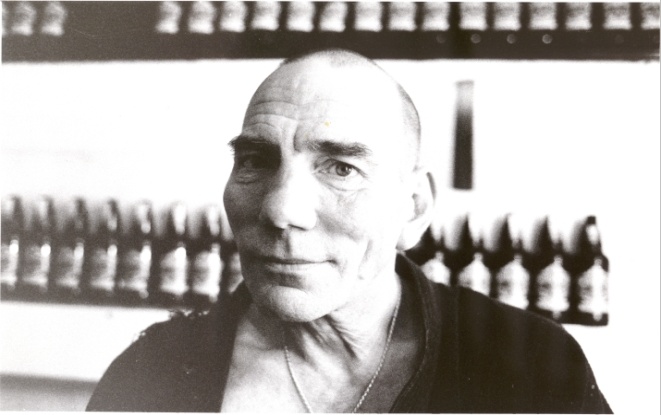
You may not know the name, but you'll certainly know the face. NIC JONES tried to find what lurks behind the face that is PETE POSTLETHWAITE.
There is something refreshingly unactorish about the man in dressing room one. This man is perhaps destined to join the roll of honour of the great, or at least most
cigarette smouldering in an ashtray. A spry but careworn man of somewhere between forty and fifty. It's hard to say exactly - his recently shaven head having the odd effect of rejuvenating
above the swollen looking cheekbones that seem to make up most of his face. The nose is certainly not of the button variety. The word "striking" springs to mind, but perhaps with a
person
singular beloved of his sometimes self-obsessed trade. But he has
little cause to be so self-effacing. He has just kept a matinee audience
of school kids rapt, reigned in from extracurricular activities, and engaged in the play. "They were there with it. We've had
letters from schools and kids and everything in reply to a whole debate that's going on in the local paper after their critic gave it a bad review. This got everybody's hackles up and
and bad reviews, the cast's experiences. "It's become a remarkable book, to the point that I can't go anywhere without it now!" He clearly sees Macbeth as a learning
start out as an actor. "No, I was a teacher first, 'cos you couldn't really be an actor in my day when you were from Warrington! That wasn't really the kind of thing you did. I left teaching
There is more than a whiff of the favourite teacher about him in a kind of “Dead Poet's Society” way; inspiring, encouraging, contageously enthusiastic. He seems to relish
the "don't tamper with the text" brigade (scenes have been cut, rewritten and transposed). Director and soul mate George Costigan has taken other liberties to reach out
Labour Party's recent television election campaign. In all these Postlethwaite possesses a blokeishness that is absolutely genuine and often inseparable from the parts he plays.
you might as well tackle something like that. It's been several years since we did any theatre, and even longer since we did Shakespeare, and he ain't easy that man. He is when you get on top of him, and then he helps you fly with him, but if you try to go against him he'll win every time." This could almost be a boxer sizing up an opponent, and the Postlethwaite face does
has been such a success. I'm sure it's helped. I'm sure people are curious." Actors often say that they prefer the feedback of a live audience. This matinee
crowd
were certainly with him all the way, as gripped by him as Postlethwaite
himself seemed gripped and sometimes even possessed by the character. 'He takes over, I go for a ride every
"I've no idea, no idea." He pauses to sip his Murphy's. "That's one of the beauties of being an actor, you're actually allowed into situations like that where you can release all
sorts of things in a way, it's quite cathartic really, quite liberating that you can actually go there, and particularly with that richness of language." But what sort of things is he
and he alone who conjures up the ghosts, without the aid of any theatrical trickery. Is Postlethwaite
Macmurphy in Cuckoo's Nest and in examining that I actually did go off the rails. I got completely paranoid. Anything that came over the tannoy I believed was a coded
Dream. So that was a definitive admission, and a definitive ambition, which then one had to live with."
work was so delicate, so vital and so important to us that you couldn't run away from it, and that linked into the play which is also about our fears. I had to face up to the
learning and self discovery? "I'm fifty-one, for goodness' sake. You know, you realise that change is actually essential, you go with it or you don't. I think
open and your heart's open. I think the whole of life's a learning process and long may it be so. So that's really why you'd go on a journey like Maccers." Postlethwaite certainly opens his
of himself into his Macbeth and it seems to have paid off. As I'm sure he would agree, if you don't put anything in, you get nothing back. No deposit, no return. Now, about those bottles?
"I'll have to crate them up at the end of the run and send them back to the bar...." No matter how philosophical he gets,
Peter Postlethwaite at rehearsals in Bristol Old Vic for Macbeth. |
 | ||||||
| Systems of Rehearsal ; Bertolt Brecht. Brechts understanding of Stanislavsky is loaded with images of coercion. For Brecht the Stanislavskian theatre 'systematically compells the empathy of the spectator' who is then a victim of hypnotic experience, .....completely entangled' in the action. Brecht is clear: this 'forcing of empathy' must stop for he argues, how is the spectator to be made to master life when all that happens masters him? There is a hint here of the larger political purpose of which this confrontation with Stanislavsky is a microcosm. The situation of Stansilavsky's audience is analogous to that of the proletariat who are the passive object of politics and must also be freed. The effect Stanislavskian drama has in common with political oppression is enforced submission. Theatre which naturalizes social reality is oppressive in that it compels assent. |
 | |||||||||||||||||
| Macbeth Rehearsal Drawings by Jonathan Polkest 1998 |
 | |
| No one seriously concerned with the theatre can by-pass Brecht. Brecht is the key figure of our time, and all theatre work today at some point starts or returns to his statements and achievements, Peter Brook. |
 | ||||
| The most beautiful of all doubts |
Is when the downtrodden and despondent raise their heads
and
Stop believing in the strength
Of their oppressors.
Oh, how laboriously the new truth was fought for!
What sacrifices it cost!
How difficult it was to see
that things were thus and not thus
Bertolt Brecht
and
Stop believing in the strength
Of their oppressors.
Oh, how laboriously the new truth was fought for!
What sacrifices it cost!
How difficult it was to see
that things were thus and not thus
Bertolt Brecht

In the 1990s Steve Rebbeck and Dick Penny's production company Rebbeck Penny co-produced Macbeth, starring Pete Postlethwaite, with Bristol Old Vic for a UK tour, and in 2001 Scaramouche Jones, which also starred Postlethwaite, for a UK and world tour.  actor Chiwetel Ejiofor talking about his acting: I remember getting cast in Amistad and getting this very strong feeling that I had overshot myself. It was a great shock. It made me realize that this is not a profession you can predict; that you can have all these ambitions and expectations and that they can all be thrown to the wind. What was peculiar about that situation was that my aspirations were so far below what actually happened. I like to disappear into a role. I equate the success of it with a feeling of being chemically changed. I always thought of the play as a sequel to Romeo and Juliet. I think Shakespeare's so astute in his understanding of people being vulnerable, you know. And that love is so easy to corrupt. I think so many of Shakespeare's plays are about how fragile love is - how perfect and beautiful it is, but also how terrifying and easy to manipulate it is. But these are the realities of the artistic idealism and the stock, the commercial/financial realism, and, so, somehow sometimes it is going to work in your favor and sometimes against, and that's all part and parcel of it. We just, in our end, just carry on trying to sort of produce the work, or the best work we can do, and hope that at their end they find a way of getting that to as many people as possible in the cinema medium. I think I just look for what appeals to me, and maybe what appeals to me is kind of serious sometimes. I like characters and I like story and I sort of like narrative, and that is what excites me. And sometimes, I suppose, in the contemporary context a lot of that is based around dramas these days so I enjoy that and it's what I have always done. I have always been involved in drama, and somehow that is where a lot of the good stories are. And I think there can be comedic moments in drama, like in Kinky Boots, I think there are some funny beats, but the overall, I'm just saying, is that it is a complex story between a few groups of people, and even though the story is heightened and amusing, there are all sorts of beats and machinations that go on and I think that's just what intrigues me and that's what I pursue.   
| ||||||||||||||||||||||||||||||||
| Drawing In Performance is actually drawing in rehearsal, weirdly intrigued by the idea of memory and how memory is used in a very precise way for rehearsals although I insist on rehearsal being extremely various in execution - the general idea was/is/could be to practice by rote and perfect each move each syllable and yet this is far from realistic. So many incredible things are discovered in a rehearsal, how are they faithfully recorded? And really are they developed memorised activities or does something quite separate take over |
 |
| Drawing in Performance in this particular blog is drawings I made of rehearsals for the Scottish Play, it is perhaps stereotypical of the artist to say what a great privilege it is to be present in rehearsals and to endorse such an extreme detached presence among the many interlocking sensitized needs of characterization, the actors are preparing their landscape in their collective minds. To the onlooker the situation looks banal and urbane as each real person immerses themselves into a shared psychosis becoming less and less conscious of the old bed, the broken chair and the sagging curtain rails, even their clothing seems to represent far less to do with their everyday identity, remaining in this absentee filled rehearsal room, the actors retain that same focus of attention that children seem to have naturally bestowed upon them and ordinary adults discard as foolish. |

 |
| Rehearsals evoke a very particular set of rituals and rites, although there could be sequences of action, memorising, reasoning there is a general sensitising to the text and to the mind set of location that brings these widely spread people and roles together in one place, as it happens an imagined place marked out on the floor w3ith little bits of elex tape and random pieces of furniture representing features yet to be realised in this landscape of collective memory. |

From; Systems of Rehearsal, Stanislavsky, Brecht, Grotowski and Brook by Shomit Mitter
 |
| The Appraisal of The Facts |
In Creating a Role, Stanislavsky maintains that "in the language of the actor to know is synonymous to feel" by feeling something actors can be satisfied that they are intimate with it in a fullness that approaches the required condition of being that thing. In the alchemy of drawing reality from representation, the actors problem is therefore primarily that of knowledge. To know is to feel and to feel is utterly to be, then to know is, by logical extention, to be. To know more about a character is to experience it more fully and eventually seamessly to become it.

The term "Archeometre" originates from the Greek
and means "the measure of the principle". The system refers also to a
series of symbols and meanings, which refer to the federal drawer.
'Archeometre' is it the measurement of the 'Archee' (Universal Cosmic Force) of which the Hermetists speaks. Is it a process, a 'key' which makes it possible to penetrate the Mysteries of the Word. It is a measuring instrument of the first (primary) principles of the manifested universe.
Alexandre Saint Yves d'Alveydre's Archeometre shows the original Atlantean alphabet translates into the material the word, form, color, smell, sound and taste, the key to all religions and the sciences of antiquity.
The Archeometre is represented by a circle, which has two scales from 0 to 360 degrees and 360 degrees to 0. It is divided into 12 ranges with 30 degrees each. In the individual ranges are drawn in the tierkreiszeichen, planet, colors, tones and the letters of different alphabets.
The Archeometre is a universal canon (guide), which wants to point the relationship out between the astrological indications, tones, smells, letters and colors. The musician finds therein the color of tones, the writer the toncharakter of letter etc. The Archeometre is to also point practical use out that the religions, arts and architecture a synthesis from different ranges to form.
'Archeometre' is it the measurement of the 'Archee' (Universal Cosmic Force) of which the Hermetists speaks. Is it a process, a 'key' which makes it possible to penetrate the Mysteries of the Word. It is a measuring instrument of the first (primary) principles of the manifested universe.
Alexandre Saint Yves d'Alveydre's Archeometre shows the original Atlantean alphabet translates into the material the word, form, color, smell, sound and taste, the key to all religions and the sciences of antiquity.
The Archeometre is represented by a circle, which has two scales from 0 to 360 degrees and 360 degrees to 0. It is divided into 12 ranges with 30 degrees each. In the individual ranges are drawn in the tierkreiszeichen, planet, colors, tones and the letters of different alphabets.
The Archeometre is a universal canon (guide), which wants to point the relationship out between the astrological indications, tones, smells, letters and colors. The musician finds therein the color of tones, the writer the toncharakter of letter etc. The Archeometre is to also point practical use out that the religions, arts and architecture a synthesis from different ranges to form.
| A Rehearsal Room in Bristol Old Vic Theatre |

Daisetz Sukuki, writing in the realm of Zen Buddhism, maintains that "man is a thinking reed but his greatest works are done when he is not calculating or thinking". The methods of Zen Buddhism begin with the assumption that enlightment comes only with the obliteration of conscious purpose. If one lets the unconscious work without conscious interference, the body somehow works more efficiently. If one does not, the body becomes tense and even the most normal motor functions become difficult. Theatre is not immune to such self consciousness. Most actors know that the more one thinks about what one is doing, the more difficult is to do it. The more clearly one works out what one is going to do on stage, the worse the result. A conscious awareness of the image that is required leads actors to imitate it rather than live through the experience of which that image should naturally be the creative result.

The discomfort of unreasonable presence on the stage and the conscious inner truth of reasoned presence and action on it, controlled Stanislavsky's actions on the stage from his earliest years into maturity as a performer."An action is only meaningful if it is real, and reality is a function of reason.


At the end of the day, acting is all about
telling lies. We are professional imposters and the audience accept
that. We`ve made this deal that we tell you a tale and a pack of lies,
but there will be a truth in it. You may enjoy it, or it will disturb
you. Pete Postlethwaite
  | |
| In Performance Drawings of a Rehearsal of MacBeth at Bristol Old Vic by Jonathan Polkest |
 | |||
| Pete Postlethwaite rehearsing MacBeth at Bristol Old Vic Theatre directed by George Costigan. |
 MACBETH, BRISTOL OLD VIC George Costigan's production interprets Macbeth's "I conjure you" very literally, turning him from pilgrim to the black shrine to master warlock himself, summoning forth the bloody child et al with his own pricking thumbs. This is less a man led astray by glowing promises and vaulting ambition, and more a willing Faust, transforming from innocent to magus. The production is littered with stylistic devices which elicit only the response "Why?". The cast are dressed like an explosion in a costume store, a jumble of periods and wardrobe bric-a-brac which neither please the eye nor aid the understanding. Macbeth and Banquo enter in crimson cassocks swathed in bullet-proof vests, parachute harnesses and swords, like members of a monastic SWAT team. The one suggestion which does succeed is that the Macbeths are unspeakably naff. From the leopard skin bedspread through the coronation fanfare of "We Are The Champions" to Macbeth's white dinner jacket at the banquet, the couple have all the sophistication of a neo-Georgian mansion in Basildon. Clearly the nouveau riche - or in this case the nouveau royale - can only achieve their success through a pact with the Devil. Yet any flaws in this production are redeemed by Pete Postlethwaite's Macbeth. At hearing the weird sisters' first prediction, he has the glazed and joyfully startled look of a lottery winner. His first encounter with his wife is the unfettered delight of a couple who can't believe they've hit the jackpot. Although the build-up to the assassination sees him more chattering than fretting, thereafter his performance lifts off with the stately grace of an Atlas rocket. Reduced to near-hysterical post-homicidal gibbering, his "Wherefore could not I pronounce 'Amen'?" is a moment of pure heart-rending anguish. From that point on, Postlethwaite rides the rollercoaster of emotion, through possession and psychosis, writhing in agony as he is broken on Fortune's wheel. Internal torment and external violence balance on a knife-edge - the "tomorrow and tomorrow" soliloquy is an embittered blast of pain and anger as he strangles the messenger who brought news of his wife's death. "Out, out brief candle" indeed! The other actors struggle to stand out against this megawatt glare of talent. Patricia Kerrigan (Lady Macbeth) is considerably better at high emotion than high treason. It's only when Lady M. starts to come apart at the seams that she gets into her stride - up to then she rattles through the lines as if fearing she'll miss the last train. Chiwetel Ejiofor gives an excellent performance as Malcolm - a cool politician, utterly controlled and delivered with icy precision -and only he and Richard Howard (Duncan/Porter/Doctor) can even begin to rival Postlethwaite for stage presence. The powerful depth and complexity of emotion which Postlethwaite can project through the close-up of the movie camera transfer with rolling resonance to the stage. Whatever else this production may lack, that alone makes this Macbeth a must-see. TOBY O'CONNOR MORSE Macbeth is at the Bristol Old Vic until 1 November (box office: 0117 987 7877), after which it tours to Liverpool, Belfast, Bradford, Guildford and Nottingham. |


Drawing Jazz in a non figurative state of mind


 |
| Two-dimensional images contain a capacity for spatial illusion. |

 |
| Objectivity as a grand illusion |


performance is a form of process acted out in real time.


Votive Drawings an exhibition by Jonathan Polkest
Bromley Arts Council
London BR1 2PX
Some background information about 24 small works in this exhibition. Originally the main body of these small votive drawings began in the early 1990’s in the British Museum London and in NSW Art Gallery Australia. The idea of investigating such potent symbols was as much a personal quest to interpret the clouded expressions of human existence in the face of the obfuscated historical background so often overlooked by mainstream historical analyses.
The Votive Drawings exhibition has been shown over the last decade in many guises, gradually becoming less in number as works were sold and not replaced but taking on different nuance reflecting the place and time in which they are shown.
1.votive painting of Wicca. Water based gouache on gesso board.

*
2 votive painting of Rosewall, Acrylic Gesso on panel*

3 Cycladic Head with gold leaf ground

4 Coquille St.Jacque silver point on gesso panel

5 Votive Roman Horse – Epona

6 Romano Celtic Bronze Boar

7 Blue bronze boar

8 Ganesh – graphite ground on gesso panel.

9The Rillaton Cup – an object from Cornish antiquity.

10.Head of a Cat – gold leaf & encaustic on panel

11. Cycladic Head II silver point on panel

12. Chariot Talisman of a man with a boar.

13. Samothracian Boar effigy

14.Khymer Head of a Princess

15. Scallop of St.James Santiago de Compostella

16. Ceramic Boar maquette

17. Cycladic Head III

18. Australian spinifex handled stone blade knife

19. drawing of a ceramic Chinese Boar on panel with pigment

20 drawing of an Egyptian Head carved in Granite in the BM

21. drawing in graphite on abraded gesso panel of a calf’s head

22. Cornish Greenstone Axe head on softwood panel

23. Kuber vedic idol of the god of wealth.

24. a small votive painting of a horse*

*denotes not in original exhibitions Sydney, Brighton, Waterford and Camborne.


Great blog Jon. Lovely drawings of Macbeth rehearsals
ReplyDelete